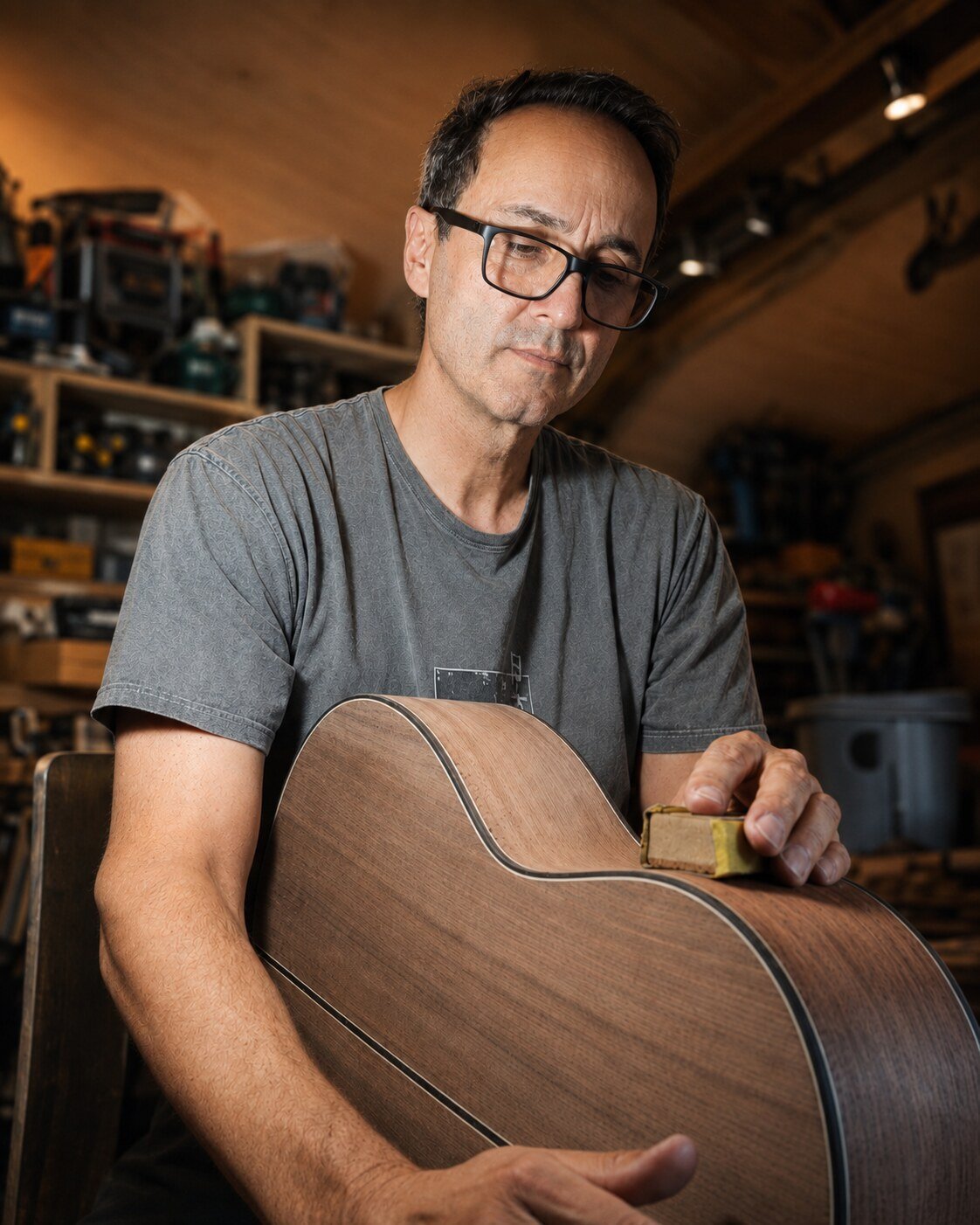
At the Workbench
Building within the Spanish tradition,
while developing a voice of my own.
I build classical guitars by hand in my workshop in London, following the traditional Spanish method of construction.
My aim is to make instruments that are responsive, balanced and clear, with good separation between the voices, enough projection to carry, and warmth and character of their own.
Each guitar is built individually. Decisions about thicknessing, bracing and voicing are made as the instrument develops rather than treated simply as a set of fixed dimensions to reproduce.
My approach has been shaped by training in Spain and by the traditions of Spanish guitar making, but I have deliberately avoided building directly from the plans of historic instruments. Many excellent guitars are made in this way; my choice is simply a different one.
Approach
Learning through the instrument itself
Rather than beginning with somebody else's answer, I want the sound of my guitars to develop from what I have learned at the workbench.
I want to understand why I make a brace a particular size, why I leave a soundboard at a particular thickness, and what happens when I change something on the next instrument. Working directly from an established plan can produce a very fine guitar, but it also provides many of those decisions in advance.
The route I have chosen may be slower. It inevitably involves experimentation, listening and occasionally finding that a decision does not lead quite where I expected. But that process matters to me because the knowledge gained becomes part of the next instrument.
The guitars are not intended to be copies of one another either. What I learn from one becomes part of the next. Over time, it is that continuing process that shapes the sound and character of an Edward Hempton guitar.
Materials
Wood chosen for the instrument
I source my timber from a small number of long-established specialist suppliers rather than buying widely. This gives me confidence in both the material and its provenance while allowing me to build a greater understanding of the wood I am working with.
For me, good instrument wood is not simply about dramatic figure, rarity or a label attached to a particular species. What matters is the piece of wood itself: its weight, stiffness, response and whether it is right for the guitar I want to build.
If you would like to discuss one of my guitars, arrange to see an instrument, or talk about a future commission, I would be pleased to hear from you.
Get in touch →